
During the Cold War, the United States and the Soviet Union gradually recognized each other as co-equal great powers. When the Berlin Wall fell (1989), both sides agreed that they were “winners.” However, when the Soviet Union collapsed in 1991, the West forsook the “parity” principle, and inclusiveness within the European security structure was brought into question. The United States and its European allies became the single, prevailing force in Europe. This paper will examine the question: Why was Russia more or less excluded from the European security architecture after the Berlin Wall fell? Instead of embracing Russia by building European security architecture that Russia could join, the West gambled that Russia would accept the EU and NATO. I will elaborate on one part of the military aspect, the “parity” principle after the Berlin Wall fell, which I found the most intriguing.
According to terms of the 1945 Yalta Agreement, the post-war European security structure was founded on the concept of shared spheres of influence between the Western bloc of nations, led by the United States, and the Eastern bloc, led by the Soviet Union. Although opposing ideological interests of the two blocs were soon to give birth to the Cold War, both sides agreed not to interfere excessively in each other’s internal affairs and shared a mutual commitment to peace in Europe.
After the collapse of the Soviet Union in 1991, the United States and its European allies became the single, prevailing force in Europe. The North Atlantic Treaty Organization (NATO) and European Union (EU) expanded their security and stability influence by engaging Easter European countries. The EU encouraged Eastern European countries to build democratic institutions, the rule of law and a market economy. In 2004, Poland, Hungary, Slovenia, Slovakia, Malta, Cyprus, the Czech Republic and the Baltic states (Estonia, Latvia, and Lithuania) became new members of the EU. At the same time, the EU developed outreach programs to East European and post-Soviet republics: European Neighborhood Policy (ENP), Eastern Policy (EaP), and Association Agreement (AA). By 2021, the EU had expanded its membership to twenty-seven countries. However, Russia regarded the EU’s growth as an enlargement of the West’s sphere of influence in the East. Moreover, Russia felt excluded because it was not invited to join in EU projects and initiatives.
NATO was founded in 1949 to protect the Western bloc from Soviet expansionism and encourage European political integration. The founding members were: Belgium, Canada, Denmark, France, Iceland, Italy, Luxembourg, Netherlands, Norway, Portugal, the United Kingdom, and the United States. As a counterbalance to NATO, the Soviet Union established the Warsaw Pact as a military complement of the Council of Mutual Economic Assistance (CoMEcon) in 1955. Members of the Warsaw Pact were: the Soviet Union, Albania, Czechoslovakia, Poland, Bulgaria, Hungary, Romania, and East Germany. Yugoslavia was the only Eastern European not to join and remain unaligned. The Warsaw Pact sought to deter eastern expansion by NATO and expand its military forces within Eastern Europe during the Cold War.
When the Warsaw Pact dissolved in 1991, NATO had to redefine its reason for existence. In 1999, NATO reasserted its presence by expanding eastward. While some Eastern European countries already wanted to become NATO members, a NATO campaign attracted others. By applying for NATO membership, Russia was tolerant of NATO expansion at first. However, with the replacement of its foreign minister, Andrei Kozyrev, in 1996, Russia’s objection to NATO’s bombing of Serbia over the Kosovo crisis without them and the acceptance of new NATO members (Poland, Hungary and the Czech Republic) all in 1999, it became clear that Russia was signaling a new resistance to NATO’s eastward expansion.
The Munich conference marked an even clearer turning point in Russian foreign policy towards the West. President Putin openly expressed dissatisfaction with Western policies toward Russia at the 2007 Munich Conference. He described the United States hegemony as “almost uncontained hyper use of force in international relations.” More to the point, he expressed doubt about NATO’s pledge to the Soviet Union that it would not expand to the East. Russia’s growing distrust and resentment of NATO’s eastward expansion was evident in its military operations of Georgia in 2008, and Ukraine in 2014 and 2022.
Great powers are sensitive about perceived security challenges near their borders. One need look no further than the US’s stern response in the Cuban missile crisis of 1962 to understand that the dynamic can cut both ways. Red China’s position on the presence of independent Taiwan off its eastern coast is another notable example. If the Soviet Union had won the Cold War and accepted Mexico and Canada into the Warsaw Pact, the United States’ reaction may have been similar to Russia’s response.
Rajan Menon and Eugene Rumer rightly point out that the “entire post–Cold War European political and security architecture was built on the foundation of two institutions— the European Union and NATO—which did not include Russia.” This paper will examine the question: Why was Russia more or less excluded from the European security architecture after the Berlin Wall fell? Instead of embracing Russia by building European security architecture that Russia could join, the West gambled that Russia would accept the EU and NATO.
The West was reluctant to accept Russia in the European security architecture for several reasons: historical, geographical, political, geopolitical, cultural, and military. I will elaborate on one part of the military aspect, the “parity” principle, which I found the most intriguing.
When the Soviet Union collapsed, the “parity” principle between two opposing blocs disappeared with the ascendancy of the Western bloc in Europe. The European security structure remained divided between NATO and non-NATO states. However, NATO’s eastward expansion made Russia more insecure about Western ambitions in Europe. In analyzing the issue, I will rely on the National Security Archive, which casts a new light on the question about whether the West promised the Soviet Union not to expand NATO eastward.
During the Cold War, the United States and the Soviet Union gradually recognized each other as co-equal great powers. Stephen Cohen termed this recognition as equal powers “parity.” For Cohen, the three elements of the United States-Soviet Union “parities” were: 1) Both sides demarcated their respective spheres of influence with “red lines;” 2) Neither side would interfere in the other’s internal affairs; and 3) Both sides shared a mutual agreement on the parameters of peace and security in Europe. This “parity” enabled both sides to keep from turning the Cold War into a hot one. While proxy hot wars broke out from time to time (e.g., Vietnam, Afghanistan) direct confrontations were few.
When the Berlin Wall fell, both sides agreed that they were “winners.” In December 1989, President George H.W. Bush convinced President Mikhail Gorbachev at the Malta Summit that the United States “will not take advantage of the revolutions in Eastern Europe to harm the Soviet Union.” On January 31, 1990, West German Foreign Minister Hans-Dietrich Genscher said, “that the changes in Eastern Europe and the German unification process must not lead to an ‘impairment of Soviet security interests.'”
On September 12, 1990, at the final meeting for German unification, multiple memoranda of conversation between the high representatives of the Soviet Union and the Western countries (Genscher, Kohl, Baker, Gates, Bush, Mitterrand, Thatcher, Major, Woerner, and others) offered assurances about “protecting Soviet security interests and including the Soviet Union in new European security structures.” Again, on February 9, 1990, James Baker, Secretary of State, assured President Gorbachev three times at a meeting in Moscow that, “not only for the Soviet Union but for other European countries as well, it is important to have guarantees that if the United States keeps its presence in Germany within the framework of NATO, not an inch of NATO’s present military jurisdiction will spread in an eastern direction.”
However, some policymakers claim that NATO’s pledge of non-expansion to the East is a part of “Russian adventurism.” In other words, they claim that this pledge never really happened. Mike Kramer claims that NATO’s non-expansion pledge is a “myth:” “No Western leader ever offered any ‘‘pledge’’ or ‘‘commitment’’ or ‘‘categorical assurances’’ about NATO’s role vis-a`-vis the rest of the Warsaw Pact countries,” and “the issue never came up during negotiations on German reunification.” Moreover, in 2014, NATO claimed such a promise was never expressed: “No such pledge was made, and no evidence to back up Russia’s claims has ever been produced.” This statement justifies the Western powers position and nullification of the “parity” principle in the European security structure after the Berlin Wall fell. Even if the NATO statement is truthful, should not NATO have been able to foresee the reaction and consequences that NATO eastward expansion would create when it awakens a “Big Bear.”
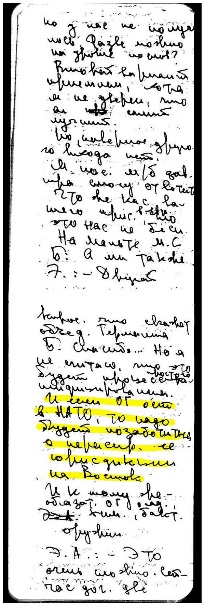
One could also say that President Gorbachev missed the opportunity to get written assurance and “missed opportunities to challenge the United States on the topic later.” This finding implies that informal agreements are not a standard diplomatic practice, but this is not always the case. In 1962, the Cuban missile crisis was partially resolved by just such an informal agreement between the United States and Soviet Union.
After the meeting with President Gorbachev in February 1990, Baker spoke with West German Chancellor Helmut Kohl and told him that he asked President Gorbachev: “Would you prefer to see a united Germany outside of NATO, independent and with no U.S. forces, or would you prefer a unified Germany to be tied to NATO, with assurances that NATO’s jurisdiction would not shift one inch eastward from its present position? He answered that the Soviet leadership was giving real thought to all such options [….] He then added, ‘Certainly any extension of the zone of NATO would be unacceptable.'” On May 4, 1990, Baker convinced Edvard Shevardnadze, the Soviet minister of foreign affairs, that, “the process would not yield winners and losers. Instead, it would produce a new legitimate European structure that would be inclusive, not exclusive.”
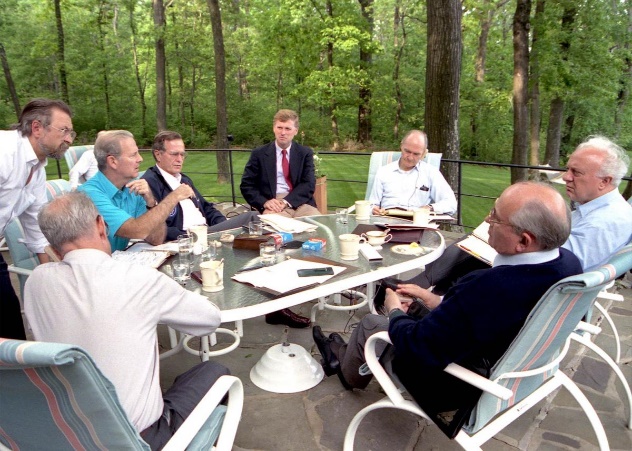
However, when the Soviet Union collapsed in 1991, the West forsook the “parity” principle, and inclusiveness within the European security structure was brought into question. In 1992, President George H.W. Bush declared in the State of Union: “By the Grace of God, America won the Cold War.” Because Western power prevailed, the European security structure evolved into a new dynamic toward Russia. When one global power suddenly stands alone without its former counterpart as a balance, it is difficult to resist that power. Power, not principle, is what motivates a great power. On February 24 – 25, 1990, at a meeting with high representatives of West Germany at Camp David, President George H.W. Bush stated that “[T]he Soviets are not in a position to dictate Germany’s relationship with NATO. What worries me is talk that Germany must not stay in NATO. To hell with that! We prevailed, and they didn’t. We can’t let the Soviets clutch victory from the jaws of defeat.” In June 1990, James Baker expressed a better insight into the Soviet mindset: “the Soviet Union does not want to look like losers.”
Mary Elise Sarotte describes how Russia felt defeated when President Boris Yeltsin was present at the withdrawal ceremony for the last of Russia’s troops from East Germany in 1994. The victory over Nazi Germany in 1945 is one of the defining symbols of Soviet and Russian identity and history. That day, President Yeltsin was drinking by showing “the well-known Russian vice,” conducting an orchestra and invited the audience to sing “Kalinka Malinka.” But, from Sarotte’s point of view, his behavior was influenced by his sense that Russia’s withdrawal from East Germany had more than a symbolic meaning for the Russian people. With the pull out of Russian troops, NATO forces had an open entrance to East Germany and the first step of NATO’s expansion to the East.
In the wake of this historic breakthrough, U.S. Vice President Al Gore stressed that the world is transitioning “from which might emerge either the world we have struggled so hard to secure or a world submerged in new nightmares.” Nevertheless, the Clinton Administration continued to lead U.S. foreign policy with an attitude of having overcome Russia.
President Clinton officially built somewhat policies towards Russia by including Russia in the Partnership for Peace (PfP) in 1994, and signing a Founding Act on Mutual Relations, Cooperation and Security between NATO and the Russian Federation in 1997, as did President George W. Bush with the Russia – NATO Council in 2002.
The PfP was established to build a strong military and political link between NATO, and Eastern European and post-Soviet republics. President Clinton’s goal was to expand PfP to the East without drawing another division “in Europe a few hundred miles east.” It was not clear how he could give up on creating a new division without prior agreement with Moscow. He sent General John Shalikashvili, the Chairman of the Joint Chiefs of Staff and of Georgian descent, to convince Central and Eastern European countries to support PfP.As Strobe Talbott, Deputy Secretary of State, explained, PfP could work either way: It can include Russia if a “good bear” wants, or contain Russia from future expansion. Although membership in PfP had not guaranteed NATO membership, NATO members were already debating not whether to expand NATO to the East, but “when” and “how.” PfP already provided a framework for “how” to expand NATO to the East.
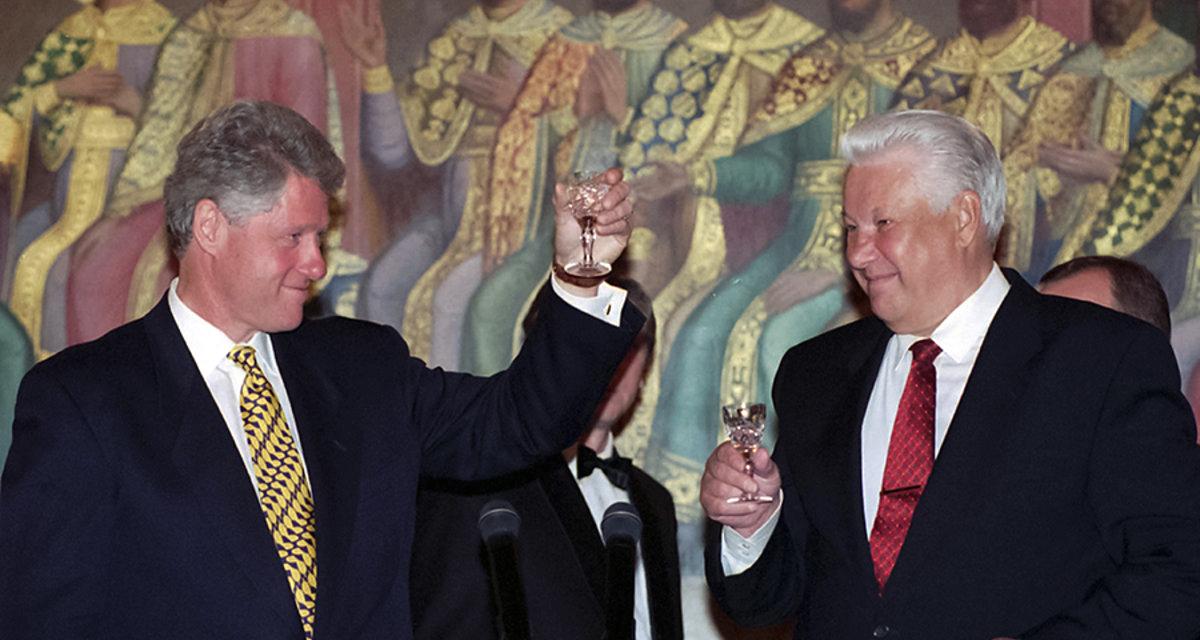
Together with an inclusive policy, the United States created an exclusive policy toward Russia by developing a strategy of NATO expansion to the East. According to Talbott, the United States had two parallel strategies: NATO expansion to the East and building security relations between NATO and Russia. The idea was to enroll Russia into PfP while NATO continued to work on the expansion. According to the records, at a meeting with President Clinton in Moscow, Minister Kozyrev realized that PfP was a mask for NATO expansion. Unlike Kozyrev, President Yeltsin argued that Russia should first join NATO, but President Clinton was not willing to address that subject during their conversation. President Vladimir Putin also talked with NATO representatives and two U.S. Presidents, Bill Clinton and George W. Bush, about joining NATO to build a new security structure in Europe. The response was that Russia should “get in line behind Estonia and Bulgaria.” Russia was humiliated.
Even though Russia sought to become an equal partner in NATO, it is questionable how Russia and the United States would have been able to work together, considering their different national interests and views on foreign policy. For instance, in 1999, NATO countries bombed Serbia during the Kosovo crisis. As a signatory of the Found Act on Mutual Relations, Cooperation and Security between NATO and the Russian Federation, Russia, as an observer within NATO without the veto, had not been consulting about the bombing. When Yevgeny Primakov, Russia’s Prime Minister, en route to the United States, heard of the bombing, he protested by turning his flight back to Moscow.
John J. Mearsheimer asserts that Russia’s reaction to NATO expansion is a basic example of Geopolitics 101: Great powers have always perceived opposing powers near their borders as possible threats. In 1962, the Cuban missile crisis introduced Soviet nuclear weapons into Cuba, within 100 miles of the United States. The world came to the brink of nuclear war because the Soviet Union had encroached on the U.S.’s zone of interest. In 2004, at the NATO – Russia Summit, President Putin expressed his disagreement with the NATO presence on Russia’s border: “The appearance of a powerful military bloc on its borders was ‘a direct threat’ to its security. ‘The claim that this process is not directed against Russia will not suffice.’”
Again, the question arises: Why does a great power encroach on another power’s zone of influence when it is sure to provoke a dangerous reaction? The answer could be to demonstrate a nation’s strength or achieve some geopolitical aim, even if the potential outcome could end in a negative-sum result. NATO’s support of Georgian and Ukrainian aspirations to the Alliance at the Bucharest Summit in 2008 led to Russian military operations of those states in 2008, and 2014 and 2022. Former U.S. Ambassador to Russia, George Kennan, said, “Expanding NATO would be the most fateful error of American policy in the post-cold-war era. Such a decision may be expected . . . to impel Russian foreign policy in directions decidedly not to our liking.”
In 1995, when NATO bombed Serbs in Bosnia and Herzegovina, President Yeltsin said that the same event could occur when NATO encroaches on Russia’s border: “The flame of war could burst out across the whole of Europe.” President Yeltsin statement is an expression of Russia’s long-standing fear of the other great power. Insecurity is an essential component of Russian life and statehood. In 1946, in his famous “Long Telegram,” George Kennan explained Russia’s view of the world across the border as a source of “traditional and instinctive Russian sense of insecurity.” The insecurity is a product of Russia’s “fear of more competent, more powerful, and more highly organized societies” on its borders. During the Cold War, the Soviet Union had ideological fear that the West will disrupt its society and destroy its traditional values. Historian G. Patrick March described Russia’s life as marked by a “paranoid fear of invasion.” Russia has always feared foreign incursion and learned to find security by destroying opposing power—rarely in compromises or voluntarily releasing territory (treaty of Alaska in 1867, and the northern Kurils in 1855). Russia learned hard lessons when Western countries and other other foreign forces walked into its heartland. Precarious security and debt (mostly to the Mongol incursion), drove Russia to its territorial expansion.
Historically, Russia, as a land-based power, has not had mountainous terrain, sea or other natural barriers to protect its territory in the same way as the United States, China or India. With this ever-present reality, Russia has sought to expand its territory as a means of deterring foreign invaders. With great expanses of flat plains or steppes as the only natural borders, Russians have always felt insecure throughout their history.
Librarian of Congress James H. Billington asserts that “geography, not history” has dominated Russians’ thinking. However, history is equally important because of the many foreign invaders who have wanted to and did conquer Russia. A persistent, preserved memory of those events is a great part of Russian identity. The Mongol invasion of 1223 and their reign lasted for 200 years; the Swedish invasion (1708); French invasion (1812); German invasions in World War I (1914) and II (1941), the surrounding of the new Soviet state by foreign powers and aid to the White counter-revolutionary forces in the Russian Civil War (1917-20) and other foreign incursions impressed upon Russia the need to build protection in the form of buffer zones around its borders. In this context, Ukraine and Georgia are buffer zones for Russia’s territorial integrity. So, in a broader sense, were the nations of the Warsaw Pact.
In this context, it is not difficult to understand Russia’s perception of Ukrainian and Georgian aspirations to NATO as a direct threat to its security. On December 17, 2021, the Ministry of Foreign Affairs of the Russian Federation sent a draft to NATO and the United States in which it was demanded that NATO and the United States withdraw their weapons and troops from the Central and Eastern European countries that joined NATO as of May 27, 1997. Those countries include Estonia, Latvia, Lithuania, Poland, Czech Republic, Slovakia, Hungary, Romania, Slovenia, Croatia, Montenegro, Albania, North Macedonia, and Bulgaria (see the map below). Russia also demanded security guarantees for the military neutralization of Ukraine.
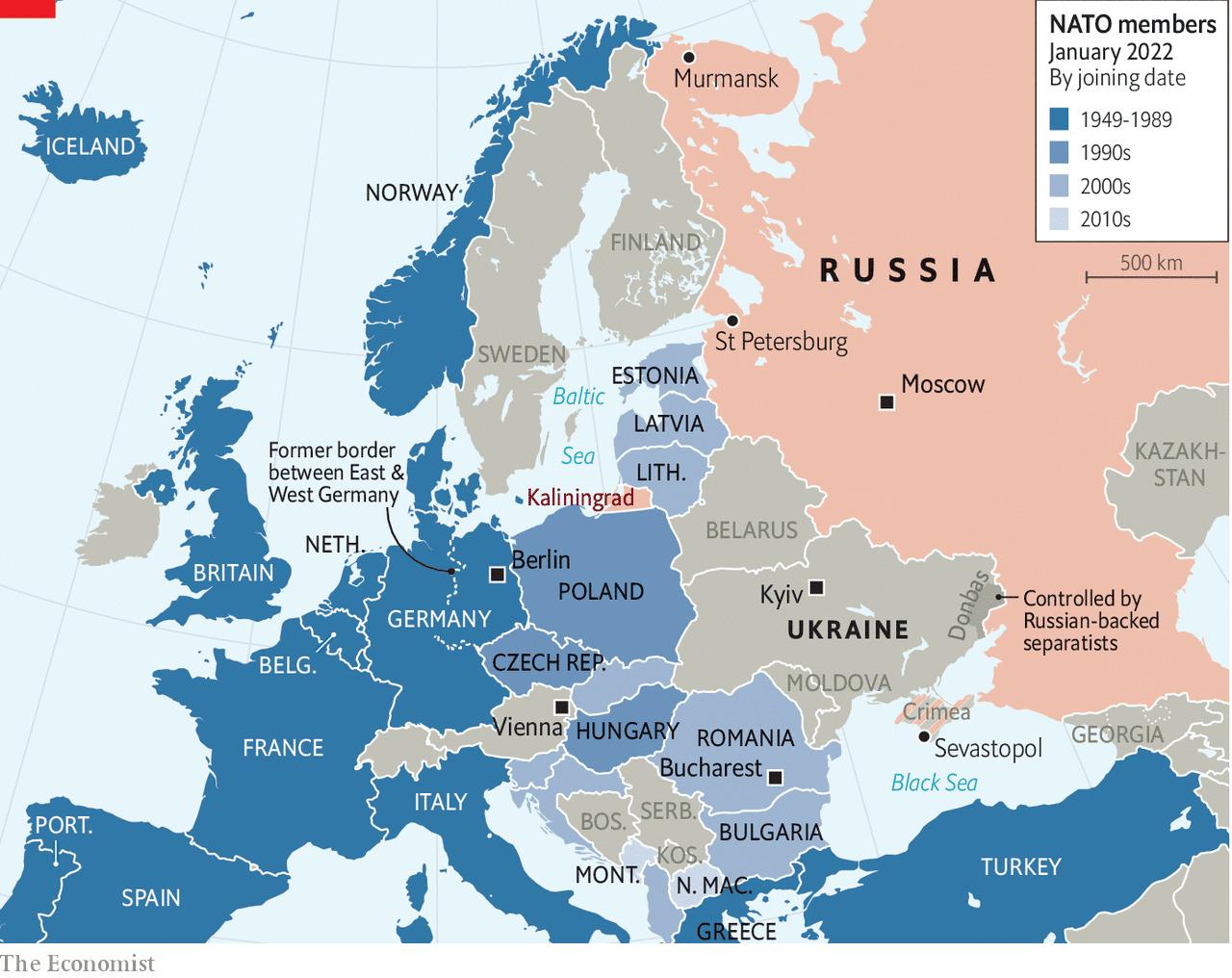
NATO and the United States rejected Russia’s demands to withdraw their weapons and troops from Central and Eastern Europe, which led up to Russia’s invasion of Ukraine on February 24, 2022. Russia is unwilling to withdraw its forces and weapons from Ukraine; nor is NATO willing to reconsider its “open door” policy towards the East. There have been no serious attempts at negotiation between the two sides.
The European security architecture involves a dividing line between the Moscow and Washington blocs once again. European security was built on the Helsinki Final Act of 1975 and the Charter for European security, Article 8, of the Organization for Security and Co-operation in Europe (OSCE) of 1999. The United States, Canada, Soviet Union and all European countries, except Albania, are signatories to the Helsinki Final Act. All agreed on the ten fundamental principles guiding relations among nations, which include: sovereign equality; refraining from the threat or use of force; inviolability of frontiers; and territorial integrity of states, among others.
The Charter of European Security, Article 8, designates that the OSCE states do not have “pre-eminent responsibility for maintaining the peace and stability in the OSCE area” or consider any OSCE area its sphere of influence. The Helsinki Act and Charter for European security, Article 8, were discarded by NATO and Russia. NATO violated the Agreements by bombing Serbia (1999) and recognizing Kosovo (2008), which violated the territorial integrity of Serbia. Russia violated the Agreements by military operations in Georgia in 2008, and Ukraine in 2014 & 2022, and also attempting to create a sphere of influence in Ukraine with the annexation of Crimea (2014), and recognition of the “Donetsk People’s Republic” and the “Luhansk People’s Republic” (2022) in eastern Ukraine. These actions resurrected a new Cold War between the United States, NATO and Russia. If it looked unthinkable after the Berlin Wall fell, the current United States – Russia confrontation has become very real and perilous. Vice President Gore’s prediction that the world can be a “nightmare” again has become a reality.
The dual nature of the United States policy of inclusiveness and exclusiveness toward Russia resulted in Russia’s growing resistance and resentment. After the collapse of the Soviet Union, the US’s primary interest remained NATO as the central pillar of the European security apparatus. Russia became an associate partner with the United States and NATO, which helped Russia to alleviate the traumas of the Soviet dissolution in the early 1990s. Instead of full integration into European security structure, however, Russia got no further than being an associate and was left on the outside looking in at the rapid expansion of NATO on its western border.
Russia’s actions in Georgia and Ukraine were motivated by deepened insecurity and a mistrust of the West. NATO’s march to the East left Russia feeling betrayed by the West in light of their earlier pledges of non-expansion. Sergei A. Karaganov, Council on Foreign and Defense Policy, stated in 2014 that Russia is treated as a “defeated power” by the imposition of a “Weimar syndrome.” Russia was no longer able to even gain entrée into international organizations, even though President Clinton told President Yeltsin that the United States will open the doors for Russia, but “you have to walk through the doors that we open for you.”
The analogy with Germany’s fate after World War I could partially help to understand Russia’s position after the Berlin Wall fell. After World War I, Germany was excluded from the European security structure, which drove the intervening developments leading up to World War II. After World War II, the United States and Europe did not want to make the same mistake. Accordingly, Germany was included in NATO and European institutions. Rajan Menon Eugen argues that the West made the same mistake with Russia after the Berlin Wall fell as they did with Germany after World War I. However, Russia could have a “special status” in the European security structure because of its geography, size, large population, imperial past, and nuclear power, all of which make the formation of a security structure more complex.
In Russia’s eyes, NATO and pan-European security architecture are mutually opposed interests. President Yeltsin advocated for a new pan-European security, but not for the “old one” [NATO]. On the contrary, the United States saw NATO as the only viable security system in Europe. Russia proposed that OSCE become a bedrock of the European security system, but President Clinton denied it. However, at another occasion, in 2010, in Paris, Hillary Clinton, U.S. Secretary of State, expressed readiness to speak about a new regional order with President Medvedev within OSCE, but Russia demurred: “Common goals are best pursued in the context of existing institutions, such as the OSCE and the NATO-Russia Council, rather than by negotiating new treaties, as Russia has suggested.” By discarding OSCE, both sides still have not found other ways to negotiate new European security structure.
In June 2001, President George W. Bush said, “We will not trade away the fate of free European peoples. No more Munichs, no more Yaltas.” Thus, Bush affirmed that no more sharing of zones of influence would occur, as with the Yalta Agreement after World War II. He thought that every country in Europe should join Western institutions and be free. In response, Russia began to build the Commonwealth of Independent States (CIS) membership. As Charap and Colton stressed, “The geo-idea of a ‘Europe whole, free and at peace’ began to collide with the other Western favorite: freedom to choose.” Sharing the zone of influence became the obstacle for in-between lands (the post-Soviet states between two great powers) to choose freely.
President Gorbachev was a proponent of a “New Thinking” in the Soviet Union’s foreign policy. He envisioned cooperation with the West without confrontation. According to Andrei Tsygankov, Gorbachev’s vision of a “common Europe home” was rooted in Nikita Khrushchev’s effort to bring the Soviet Union closer to Europe. Gorbachev sought to establish a “balance of interests” and mutual responsibility. To share joint responsibility with the West, Gorbachev negotiated the mutual withdrawal of two military blocks from Europe. However, the Warsaw Pact had already collapsed by July 1, 1991.
In addition, Gorbachev proposed disarmament deals to the West and non-intervention policies to other countries, which the West refused. With the rejection of these proposals, Gorbachev could not implement his “freedom of choice” principle for each country.
In the final analysis, both powers have a mutual stake and responsibility in building a new security structure in Europe by compromising in negotiations. The West should realize that the existing European security system can no longer work in Eastern Europe. Both sides should abstain from any military or other confrontations. Demonization of the other side should be acknowledged as nonproductive. Henry Kissinger once pointed out that demonization of presidents is not a policy; “it is an alibi for the absence of one.” When Hilary Clinton met President Putin in Saint Petersburg, she told him that she visited the Saint Petersburg Memorial. Then President Putin told her a tragic family story. Putin’s father defended Leningrad (today’s Saint Petersburg) during World War II. When he was going home from the front, he saw a pile of bodies on the street. Among the pile of bodies, he saw his wife’s shoe and he then pulled her from the pile. Amazingly, she was alive. Almost a decade later, she bore Vladimir Putin. Secretary Clinton saw a different side Putin and better understood his views on Europe and the West from that encounter.
Perhaps what is needed most is more national introspection about where we have come from and where we are headed in the aftermath of the Cold War. The Cold War had no real winner. Both sides wanted to prove their superiority over the other. Each side wanted to show that their political system was more democratic, with more respect for human rights, stronger rule of law, and higher economic and living standards. But when the Eastern bloc collapsed, the West no longer saw a need to affirm these values. So what has happened with the “winners” in the post-Cold War era? Western democratic institutions have been degraded as autocratic regimes in the guise of democracy have sprung up all over the world. Economic and living standards have fallen so that poverty and hunger are more widespread than ever before. Loss of respect for human rights and social inequality are prevalent almost anywhere we look. So who was it that “won” the Cold War? Was it the US that still feels compelled to spend more on weapons that the rest of the world combined? Now that it has sobered up from its triumphant high in the post-Cold War era, the West is facing a new reality, a “Big Bear” that has awakened. Eventually, it will dawn on the West that no one really won the Cold War. World politics is not a zero-sum game; its purpose to not defeat someone utterly, but to benefit all people and nations from both West and East.
If we all could have the opportunity, like Hillary Clinton with Vladimir Putin, to know and better understand one another, to walk a mile in the other’s shoes, we would be in a better position to create more equitable policies for the world. We survived the first Cold War, but it is still an open question about whether we will get through this second one. We need to understand soon—before it is too late—that we are living through a new and perilous turning point in a changing world order.
Milos Rastovic
Originally written as part of graduate course work at Harvard University, May 2022.