
During the latter half of the first millennium CE, Central and Eastern Europe experienced significant cultural and political changes. These shifts are often linked to the emergence of the Slavs, as indicated by written sources and the appearance of comparable archaeological patterns. However, scholars still disagree on whether these patterns resulted from population movements, cultural assimilation (Slavicisation), or a mix of both.
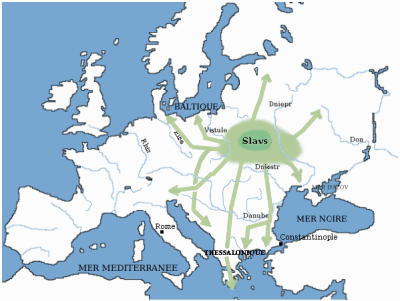
A large international research team (over forty scientists) analyzed genome-wide data from 555 ancient individuals, including 359 associated with early Slavic culture from the seventh century CE, in a study published in Nature. The findings indicate that Slavic population movements between the sixth and eighth centuries largely reshaped Eastern Europe’s population, replacing more than 80% of the local genetic makeup in areas that are now eastern Germany, Poland, and the northwestern Balkans. The study also examined genetic data from all major Slavic-speaking groups, including over 600 individuals from the Sorbian minority in eastern Germany. Results show that the Upper Lusatian Sorbs have retained a very high level—about 88%—of Slavic ancestry since the twelfth century.
The study ultimately shows that the term “Slavs” first appeared in sixth-century Byzantine sources. Western writers used it later. Early Slavic groups lived north of the Lower Danube, from where they expanded into the Carpathian Basin, the Balkans, and the Eastern Alps. Many were ruled by the Avars between the late sixth and eighth centuries. By the seventh century, Slavs occupied much of East-Central and Southeastern Europe. Older Roman and Germanic systems faded in these areas with simpler communities marked by pit houses and practiced cremation; pottery was handmade and plain; metal objects were rare. This culture is known as the Prague-Korchak group. Over time, Slavic societies became more organized. This happened through contact with Byzantium and Western Christianity. The authors also note that extended written texts in Slavic first appeared in the late ninth century.
The study finds that small-scale migration from Eastern Europe into the Balkans occurred before and alongside larger population movements, reflecting sustained mobility during the sixth and seventh centuries. The impact on local populations varied by region, with Slavic ancestry not always becoming dominant in the Balkan Peninsula and Western Russia. Where mixing occurred, indicating no strong gender bias in population integration.
The authors links the evidence from the Elbe–Saale region of eastern Germany with broader demographic and cultural changes seen across Central and Eastern Europe. Historical sources traditionally explain this regional transformation as the result of Germanic groups leaving East-Central Europe and the arrival of populations identified as Slavs after the collapse of the Western Roman Empire. This shift marks the transition from the Migration Period to the Slavic Period, beginning in the sixth or seventh century. By the seventh century, Slavs were recorded east of the Saale River and soon spread westward, creating a zone of interaction between Slavic- and Germanic-speaking communities.
The study identifies an extensive genetic network, based on shared ancestry that includes most Slavic Period individuals along with other contemporaneous populations from Central and Southeastern Europe. Within this network, two main subgroups emerge: one dominated by individuals from north of the Carpathian Mountains and another consisting of individuals buried farther south. This pattern may indicate separate geographic expansion routes or differing levels of integration with local populations. Additionally, the findings show that limited genetic movement from Eastern Europe into Pannonia and the Balkans occurred as early as the Iron Age and Roman period, centuries before the major migrations of the sixth and seventh centuries. “A substantial number of individuals within the Slavic people cluster buried in Austria, Hungary, Serbia, and Montenegro during the time period from 500 BCE to 300 CE.”
Overall, the results show that the emergence of Slavic cultures, languages, and material traditions was closely linked to large-scale demographic movements, rather than merely cultural diffusion, though local populations were variably integrated across regions.
Further information you can find in the original study “Ancient DNA Connects Large-Scale Migration with the Spread of Slavs” in the journal Nature.
